Walking into a bookstore or browsing online for a Bible can feel overwhelming. There are dozens of translations, different cover styles, various sizes, and special editions. If you’re buying your very first Bible or even replacing an old one, you may wonder where to begin.
The good news is that there isn’t one “perfect” Bible for everyone. The best Bible is the one that you’ll enjoy reading regularly and that helps you grow closer to God.
In this guide, we’ll explain the differences between Bible translations, sizes, and formats in simple language so you can confidently choose the Bible that best fits your needs.
Why Choosing the Right Bible Matters
Your Bible is more than just a book – it’s God’s Word. It encourages, teaches, comforts, and guides you through every stage of life.
Choosing a Bible that suits your lifestyle makes it much easier to build a consistent habit of reading Scripture. For example:
- A compact Bible is easy to carry every day.
- A larger Bible may be more comfortable to read at home.
- A gift Bible can become a treasured keepsake.
- A simple, easy-to-read translation helps you understand God’s message more clearly.
Instead of choosing based only on appearance, think about how and where you’ll use your Bible most often.
Start with the Translation
One of the first things you’ll notice is that Bibles come in different translations. While the wording may vary, they all communicate the same core message of God’s love and salvation.
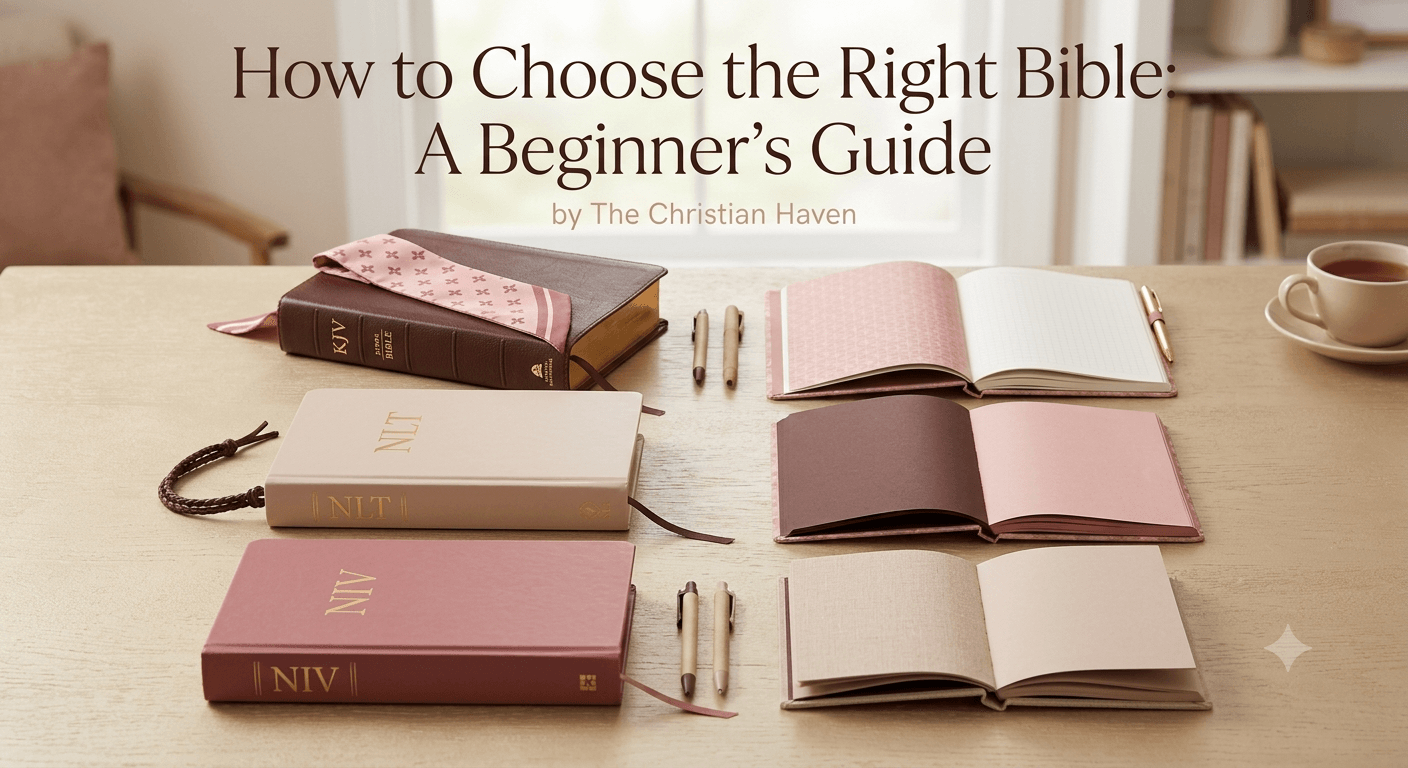
At The Christian Haven, some of the most popular translations are:
- King James Version (KJV)
- New International Version (NIV)
- New Living Translation (NLT)
Let’s look at each one.
King James Version (KJV)
The King James Version is one of the most well-known Bible translations in the world. First published in 1611, it has influenced Christian worship, literature, and history for centuries.
Many people appreciate the KJV because of its beautiful, poetic language and traditional wording.
Best for:
- Christians who enjoy classic language
- Church members whose congregation uses the KJV
- Personal devotion
- Gift giving
Things to consider
Because the language reflects English used several hundred years ago, some readers may find certain passages more difficult to understand.
If you’re comfortable with older English, the KJV remains a timeless choice.
New International Version (NIV)
The New International Version is one of today’s most popular Bible translations.
It balances accuracy with readability, making it suitable for both new and experienced Christians.
The NIV is often used in churches, Bible study groups, and personal devotion because it reads naturally while remaining faithful to the original biblical texts.
Best for:
- Everyday Bible reading
- Bible study
- Church use
- New believers
- Family devotion
If you’re unsure which translation to choose, the NIV is an excellent place to start.
New Living Translation (NLT)
The New Living Translation focuses on making Scripture easy to understand.
Rather than translating word-for-word, it communicates the meaning of each passage using clear, modern English.
Many readers find the NLT especially helpful for daily devotionals because it feels conversational without losing the biblical message.
Best for:
- Daily quiet time
- New Christians
- Teenagers
- Young adults
- Personal reflection
If you’ve ever struggled to understand the Bible, the NLT can make Scripture feel much more approachable.
Which Translation Should You Choose?
There isn’t a wrong choice.
Instead, ask yourself a few simple questions:
- Do I enjoy traditional language?
- Am I looking for easy everyday reading?
- Will I mainly use my Bible for personal devotion?
- Will I use it during church services?
- Am I buying it as a gift?
Here’s a quick comparison:
| Translation | Reading Style | Ideal For |
| KJV | Traditional | Readers who enjoy classic English |
| NIV | Balanced | Everyday reading, church, Bible study |
| NLT | Very easy to read | Beginners, daily devotion, young readers |
Remember, reading the Bible consistently is far more important than worrying about choosing the “perfect” translation.
Think About How You’ll Use Your Bible
Before making a purchase, consider your daily routine.
Will you carry your Bible to church every Sunday?
Will you take it to Bible study?
Will you read it every morning at home with a cup of tea or coffee?
Will it stay on your bedside table?
Your answers will help determine which style of Bible is most practical for your lifestyle.
For example, someone who travels often may appreciate a compact Bible that easily fits into a handbag or backpack. Someone who studies Scripture for longer periods may prefer a larger Bible that’s easier to read.
Choosing a Bible that fits naturally into your routine makes it much more likely that you’ll read it regularly.
Remember: The Best Bible Is the One You’ll Read
Whether you choose a KJV, NIV, or NLT, you’re choosing God’s Word – and that’s what matters most.
The important thing is to open it, read it, and allow it to shape your daily life.
Choosing the Right Bible Size
The size you choose can make a big difference in how often you use it. A Bible that fits your lifestyle is much more likely to become part of your daily routine.
Pocket Bibles
Pocket Bibles are the smallest option available. They are designed to be lightweight and easy to carry wherever you go.
They’re ideal if you want God’s Word close at hand throughout the day.
Best for:
- Daily travel
- Keeping in a handbag or backpack
- Commuting
- Quick Scripture reading during breaks
Pocket Bibles are convenient, but because of their compact size, the print is usually smaller.
Compact Bibles
Compact Bibles are one of the most popular choices because they offer a balance between portability and readability.
They are slightly larger than pocket editions while still being easy to carry to church, Bible study, work, or school.
If you’re buying your first Bible, a compact edition is often an excellent choice.
Best for:
- Church services
- Bible study groups
- Daily quiet time
- Students
- Everyday use
Standard Size Bibles
Standard Bibles provide a comfortable reading experience without being too large.
Many people prefer this size because it sits nicely on a desk or bedside table and is easy to read for longer periods.
Best for:
- Home Bible study
- Family devotion
- Daily reading
- Longer study sessions
Large Print Bibles
Some readers find smaller text difficult to read, especially during extended Bible study.
Large print Bibles make reading more comfortable and reduce eye strain.
They are especially appreciated by older adults or anyone who simply enjoys larger text.
Best for:
- Seniors
- Daily home reading
- Extended Bible study
- Comfortable reading
Choosing the Right Cover
Your Bible is something you’ll likely use for years, so it’s worth considering the cover style.
Different covers offer different benefits depending on how you’ll use your Bible.
Hardcover Bibles
Hardcover Bibles are sturdy and durable.
They hold their shape well and are excellent for home use, Bible study, or gifting.
Many churches also present hardcover Bibles during baptisms or special celebrations.
Benefits:
- Durable
- Professional appearance
- Great for gifts
- Long-lasting
Faux Leather Bibles
Faux leather Bibles have become increasingly popular because they combine elegance with practicality.
They often feel softer in the hand and are flexible enough for everyday use.
Many faux leather editions also include:
- Ribbon bookmarks
- Gilded page edges
- Decorative covers
- Presentation pages
They make wonderful gifts while remaining practical for daily reading.
Flexcover Bibles
Flexcover Bibles are lightweight and slightly flexible.
They’re easier to carry than hardcover editions and are designed for frequent use.
If you travel often or carry your Bible daily, a flexcover edition may suit your lifestyle very well.
Buying a Bible as a Gift
A Bible is one of the most meaningful gifts you can give.
Unlike many presents that are eventually forgotten, a Bible can encourage someone throughout their entire life.
Bibles make thoughtful gifts for:
- Birthdays
- Baptisms
- Confirmations
- Graduations
- Weddings
- Christmas
- Mother’s Day
- Father’s Day
If you’re buying a Bible as a gift, consider the recipient’s age, reading preference, and lifestyle rather than simply choosing the most decorative cover.
Choosing a Bible for Children
Children benefit from Bibles that are easy to understand and enjoyable to read.
Age-appropriate Bibles help young readers develop a love for Scripture from an early age.
You can also encourage children’s faith by pairing a Bible with:
- Children’s devotionals
- Christian colouring books
- Bible activity books
- Inspirational bookmarks
Creating positive experiences around God’s Word helps build lifelong habits.
Choosing a Bible for Teenagers
Teenagers often appreciate Bibles that are easy to read and practical enough to carry to school, youth group, or church.
An NLT or NIV translation is often a great starting point because of its clear language.
You might also consider pairing a Bible with:
- A journal
- A notebook
- Bible highlighters
- Scripture stickers
These tools encourage teenagers to interact with God’s Word rather than simply reading it.
Choosing a Bible for New Christians
If someone has recently become a Christian, avoid overwhelming them with too many study tools at first.
Instead, keep things simple.
A great starter set might include:
- An NIV or NLT Bible
- A daily devotional
- A notebook
- A bookmark
This gives them everything they need to begin building a consistent quiet time.
Think Beyond the Bible
Your Bible is the centrepiece of your spiritual growth, but a few simple accessories can make your reading experience even more meaningful.
Many Christians enjoy using:
- Faux leather bookmarks to easily return to their reading.
- Bible highlighters to mark favourite verses.
- Journals for writing prayers and reflections.
- Notebooks for sermon notes and Bible study.
- Devotionals that help apply Scripture to everyday life.
These aren’t essentials – but they can help you stay organised and engaged as you spend time in God’s Word.
Common Mistakes People Make When Buying a Bible
Buying a Bible is an exciting decision, but it’s easy to focus on the wrong things. Here are some common mistakes to avoid.
Choosing a Bible Only Because It Looks Beautiful
A beautifully designed Bible can certainly inspire you to pick it up more often, but appearance shouldn’t be the only factor.
Ask yourself:
- Will I enjoy reading this translation?
- Is the print comfortable?
- Can I carry it easily?
- Does it suit how I plan to use it?
A Bible that fits your lifestyle will serve you better than one that simply looks attractive on a shelf.
Buying a Bible That’s Too Difficult to Read
Some people choose a translation because someone else recommended it, only to discover they struggle to understand it.
If you find yourself reading the same verse repeatedly without understanding it, don’t be discouraged.
Choosing a translation like the NIV or NLT may help you engage with Scripture more consistently while still remaining faithful to God’s Word.
Building a Bible Reading Habit
Owning a Bible is only the first step.
The greatest benefit comes from opening it regularly.
Here are a few practical tips for building a lasting habit.
Start Small
Don’t feel pressured to read several chapters every day.
Begin with:
- One chapter
- A Psalm
- A Proverb
- A short passage from the Gospels
Consistency matters more than quantity.
Read with Purpose
Instead of rushing through your reading, ask yourself:
- What does this passage teach me about God?
- What can I learn about myself?
- Is there a promise to remember?
- Is there an example to follow?
- Is there something God is asking me to change?
These simple questions help move Bible reading from information to transformation.
Write Down What You Learn
Many Christians remember Scripture better when they write it down.
Keep a journal or notebook nearby to record:
- Favourite verses
- Prayer requests
- Answered prayers
- Sermon notes
- Reflections
- Lessons God is teaching you
Looking back months or years later can be a wonderful reminder of God’s faithfulness.
Create a Simple Bible Study Routine
You don’t need complicated study methods to grow spiritually.
A simple routine could look like this:
Step 1
Pray for understanding.
Step 2
Read a Bible passage.
Step 3
Highlight verses that stand out.
Step 4
Write one or two thoughts in a journal.
Step 5
Pray about what you’ve learned.
Even fifteen minutes each day can make a meaningful difference over time.
Bible Study Essentials
While the Bible is the most important tool, a few helpful resources can make your study time more organised and enjoyable.
Devotionals
Devotionals explain biblical principles in practical ways and often include daily reflections, prayers, and questions for deeper thought.
They’re especially helpful for new believers or anyone wanting guidance during their quiet time.
Journals
Prayer journals and wirebound journals give you space to:
- Record prayers
- Reflect on Scripture
- Write gratitude lists
- Track answered prayers
Many people find that writing helps them remember what God is teaching them.
Notebooks
A notebook is perfect for:
- Church sermons
- Bible study groups
- Personal reflections
- Scripture memorisation
- Lesson notes
Having one dedicated notebook keeps everything in one place.
Bookmarks
A bookmark may seem like a small accessory, but it’s one you’ll use every day.
Christian bookmarks featuring Bible verses also provide encouragement each time you open your Bible.
Whether you prefer faux leather or engraved metal bookmarks, they make thoughtful companions to your daily reading.
Bible Highlighters
Highlighting key verses can help you quickly revisit passages that have encouraged or challenged you.
Over time, your Bible becomes a personal record of your spiritual journey.
Journaling Stickers
If you enjoy creative Bible journaling, Scripture-inspired stickers can make your notes more engaging and visually memorable.
Choosing a Bible for Different Seasons of Life
Your stage of life may influence which Bible best suits your needs.
Students
Students often benefit from compact Bibles that easily fit into a school bag alongside notebooks and study materials.
Busy Professionals
A portable Bible makes it easier to read during lunch breaks or while commuting.
Pairing it with a devotional can help maintain a consistent quiet time even on busy days.
Parents
Parents often appreciate a Bible that’s easy to read during family devotion or bedtime reading with children.
Adding children’s devotionals or colouring books can make family Bible time more engaging.
Older Adults
Larger print Bibles provide a more comfortable reading experience and make daily Scripture reading more enjoyable.
Final Thoughts
Choosing a Bible doesn’t have to be complicated.
Whether you prefer the timeless language of the King James Version (KJV), the balanced readability of the New International Version (NIV), or the clear and conversational style of the New Living Translation (NLT), the most important decision is simply to begin reading.
Instead, choose one that fits your lifestyle, encourages regular reading, and helps you grow closer to God.
Over time, your Bible will become more than a book on your shelf. It will become a trusted companion through seasons of joy, uncertainty, celebration, and challenge.
God’s Word has the power to comfort, encourage, correct, and strengthen us every day. The Bible you open consistently is the one that will have the greatest impact on your life.
If you’re looking for a Bible or resources to support your quiet time, explore our collection at The Christian Haven.
Read about How to Start a Daily Quiet Time with God for more inspiration.